Sunday, 10 February 2013

Lawrence and Annesley Old Church


The photo shows the recently restored ruins of Annesley Old Church, All Saints, located in the grounds of Annesley Hall, just over two miles north of Eastwood, and close to junction 27 of the M1. The church fell into disuse after the opening of the new church in New Annesley, a colliery village which grew up in the mid-nineteenth century. Lawrence portrays the building as a romantic ruin in The White Peacock

The grassy path to the churchyard was still clogged with decayed leaves. The church is abandoned. As I drew near an owl floated softly out of the black tower. Grass overgrew the threshold. I pushed open the door, grinding back a heap of fallen plaster and rubbish, and entered the place. In the twilight the pews were leaning in ghostly disorder, the prayer books dragged from their ledges, scattered on the floor in the dust and rubble, torn by mice and birds. Birds scuffled in the darkness of the roof.
 
Today the structure is tidier but less romantic, thanks to a grant from the Heritage Lottery Fund. The upper walls of the nave and tower were removed some years ago to make the building safer, so what remains gives a very different impression to the one Lawrence portrays.

Friday, 11 January 2013

Lawrence's University College


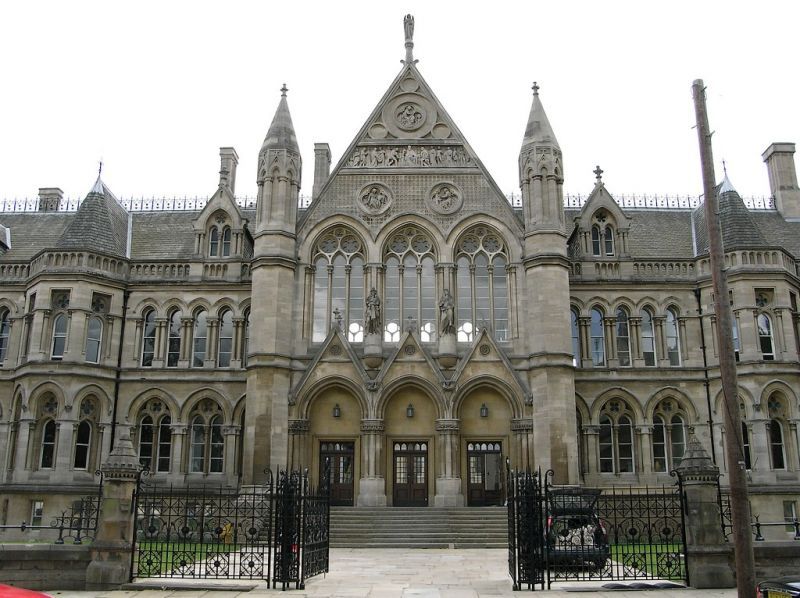
This is the Shakespeare Street facade of what was originally Nottingham's University College, and is now the Arkwright Building at Nottingham Trent University. Lawrence began studying here in 1906, and left two years later with his teaching qualification, but without a degree. Lawrence uses his experience there in The Rainbow, when Ursula attends:

The big college built of stone, standing in the quiet street, with a rim of grass and lime-trees all so peaceful: she felt it remote, a magic-land. Its architecture was foolish, she knew from her father. Still, it was different from that of all other buildings. Its rather pretty, plaything, Gothic form was almost a style, in the dirty industrial town. She liked the hall, with its big stone chimney-piece and its Gothic arches supporting the balcony above. To be sure the arches were ugly, the chimney-piece of cardboard like carved stone, with its armorial decoration, looked silly just opposite the bicycle stand and the radiator, while the great notice-board with its fluttering papers seemed to slam away all sense of retreat and mystery from the far wall.


 Today the recently-renovated building preserves all of its Gothic features, including the rather comical fireplace, although the bicycle stand and noticeboard have disappeared. Nobody would describe Shakespeare Street as ‘quiet’ now; it is the bustling heart of an international student body of over 20,000, but the extract is a reminder that a century ago this was an upmarket residential area.


Tuesday, 1 January 2013

100 Years of 'Sons and Lovers'


1913 saw the first publication of a number of novels which are still widely read, such as Proust's Swann's Way, MacKenzie's Sinister Street, Fournier's Le Grand Meaulnes and Cather's O Pioneers! But arguably the most important novel to be published in Britain that year was Lawrence's third work, Sons and Lovers.

Edited with over 80 deletions by Edward Garnett, who feared that the original text might be considered obscene, the book had previously been rejected by Heinemann. The book was the product of several years' work, and had gone through a number of re-writes, having originally been called Paul Morel, the name of the largely autobiographical hero.

Although initially seen as remarkable in presenting the lives of people in a mining community, the novel perhaps owes its lasting reputation to its depiction of the development of an example of the Oedipus complex, a phenomenon which at the time of publication had only recently been recognised. 

Wednesday, 21 November 2012

The Thorn Tree, Mansfield Road, Eastwood


Although brought up in the teetotal ethos of the Band of Hope, Lawrence wrote a surprising amount about pubs, from the Ram Inn at Beauvale (see earlier blog) to the Punchbowl in Mapperley, Nottingham. The second chapter of Aaron's Rod is set in the fictional 'Royal Oak', in reality the Thorn Tree, illustrated in the damaged photo above.

Now demolished, this stood on Mansfield Road opposite Cockerhouse Lane. In the novel the landlady, Mrs Houseley, is described as: 'a large, stout, high-coloured woman with a fine profile, probably Jewish', which doesn't seem to match the only woman in this picture. In the book she ran a special bar parlour for 'superior' customers, as she is fond of 'intellectual discussion'.

It is noteworthy that the landlady of the Thorn Tree, Ellen Wharton, was licensed to brew and sell beer, such a role being an acceptable way for a woman at that time to run her own business.

Friday, 9 November 2012

Was this the original of Mellor's cottage?


The photos shows the derelict gamekeeper's cottage in High Park Wood at Moorgreen. Today, apparently, it still stands but is more overgrown than shown in the picture.Several of Lawrence's early works, such as The White Peacock and 'Shades of Spring', are set in this area and involve gamekeepers, who can be seen as forerunners of Mellors in Lady Chatterley's Lover.

Lawrence must have known this cottage, which appears to have been solidly built if small, from his walks in the area, and clearly found the ambiguous social position of the gamekeeper fascinating. Both Annable in The White Peacock, and Mellors, are portrayed as men who have deliberately chosen their role, somewhat outside the class system, which they have rejected after flirting with the middle class. They are made the spokesmen of the 'natural', instinctive life, and to some extent may be seen as aspects of Lawrence's own persona.

Sunday, 23 September 2012

Who painted the Engine Lane Mural?


This mural contrasts two aspects of Eastwood life, illustrating two quotes from Lawrence's writing. On the left is a mining scene: 'there was a sort of inner darkness like the gloss of coal in which we moved and had our being.' This is taken from the essay 'Nottingham and the Mining Country' (1930). The right-hand panel is captioned: 'the east was tender with a magenta flush under which the land lay still and rich...', a quotation from Sons and Lovers (1913).

The underground scene shows a group of miners in a remarkably spacious tunnel; contemporary accounts speak of far more cramped conditions in most local pits. The illustration of the family out for a walk seems even more bizarre: not only is the sky pale blue rather than magenta, but the quote is from a scene in the novel when Miriam and Paul are walking alone.

In its current position it is unseen by most visitors to the town. It would be interesting to know who painted the mural, and under what circumstances?

Saturday, 1 September 2012

Barefoot in the park


In Nottingham, that dismal town
where I went to school and college
They've built a new university
for a new dispensation of knowledge

Built it most grand and cakeily
out of the noble loot
derived from shrewd cash-chemistry
by good Sir Jesse Boot

This is not Lawrence's finest poem, but it does reveal the extent of his quarrel with the University of Nottingham, as it was written many years after he had left the University College, as it was then. His hostility may have been partly due to his disillusion with the standard of teaching he experienced there in 1906.

But this seems especially ironic today, since not only has the university provided a home for the only statue of Lawrence in the world (as far as I know), but also hosts the DH Lawrence Research Centre, the DH Lawrence Pavilion, and helps to support the DH Lawrence Heritage Centre in Eastwood. Most would consider that this repays anything that the university owes to one of its most renown students.

The statue can be found outside the east entrance to the Law and Social Science building.