Tuesday, 21 May 2013

Home


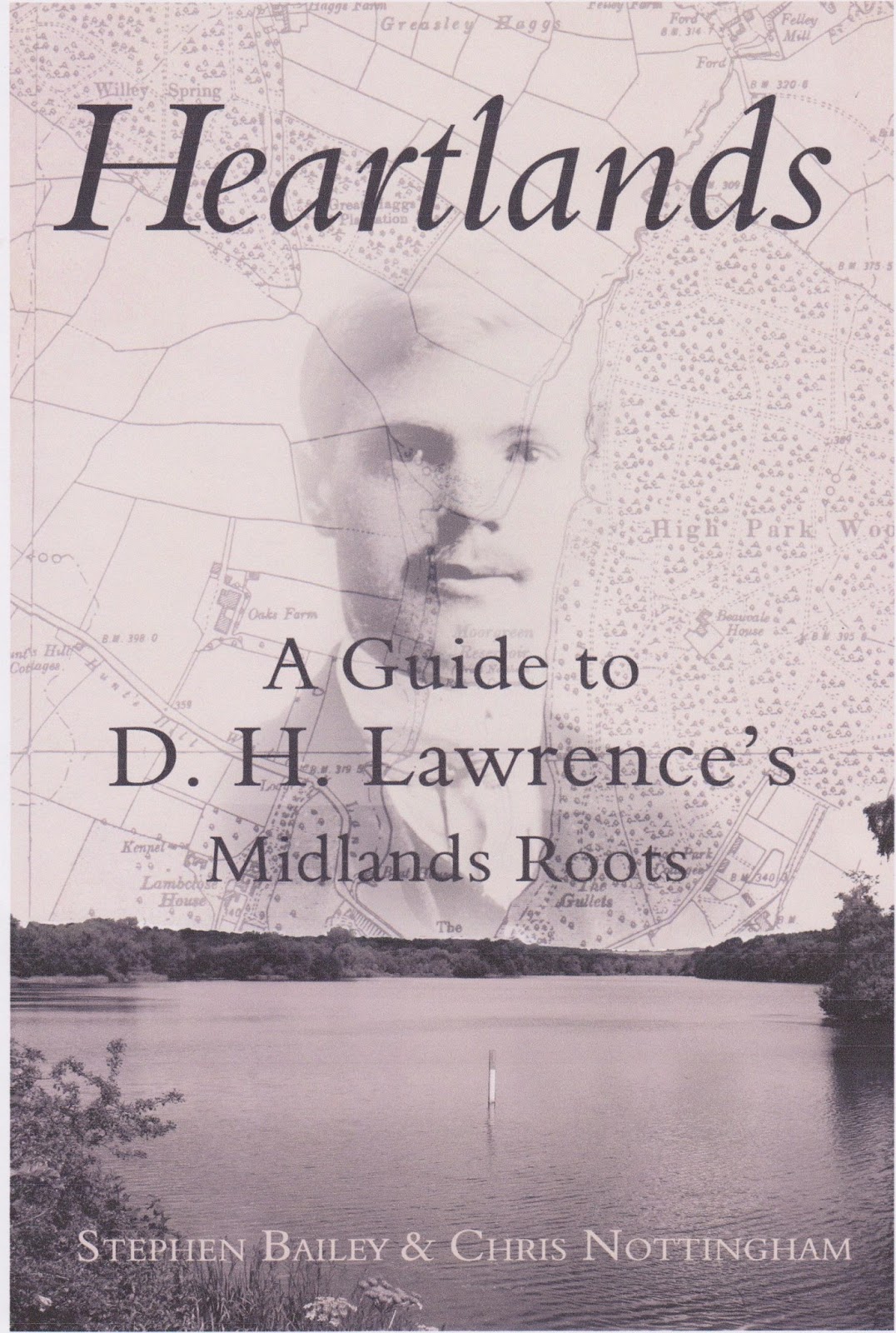
Heartlands
A Guide to D.H. Lawrence’s Midlands Roots

 Eighty years after his death D.H. Lawrence has become a celebrity, the subject of passionate dispute, possibly more discussed than read. It is time to put the emphasis back on the novels and short stories, by exploring the context that led to their creation - Lawrence’s upbringing and influences.

 Although he led a wandering life, Lawrence’s best work is located in the countryside of his youth, in Nottinghamshire and Derbyshire. An understanding of this district can help readers understand and enjoy Lawrence’s work more fully, and this book aims to guide the visitor, either in person or in spirit, around Lawrence’s ‘Heartlands’.

Heartlands also provides the reader with a biography of Lawrence’s early life, and examines the complex cultural forces that inspired the young man, revealing  the profound influences of home, school and chapel in Eastwood that led to such masterpieces as The Rainbow and Women in Love.

 Five key areas are examined in detail, with maps and illustrations:

·         Eastwood and Brinsley

·         Moorgreen and Greasley

·         Cossall

·         Nottingham

·         Derbyshire

 The role of walking in developing Lawrence’s feelings for his ‘Heartlands’ is also explored, and five walks which are described in Sons and Lovers are followed in the modern context, illustrating some of the changes that have affected the district in the past century.

The Authors first met in the 1960s as pupils at Nottingham High School for Boys, which was Lawrence’s old school, although this connection was rarely mentioned at the time.

 Stephen Bailey taught English to international students for many years, in Barcelona, Tokyo, London and Prague. He is the author of Academic Writing: A Handbook for International Students, Academic Writing for International Students of Business, and more locally, The Derbyshire Portway. He lives in Whatstandwell with his wife and daughter.

 Chris Nottingham is Emeritus Reader in Contemporary History at Glasgow Caledonian University. He is the author of The Pursuit of Serenity: Havelock Ellis and the New Politics and he writes mainly on the history of health and welfare. He lives in Ilkley with his wife and their well-behaved labrador.
 
Our book is a guide to this district, and these pages give a taste of the contents. The posts on our blog provide extra insights into some places that were important to his development.

Use the 'Pages' links (top right) to see the contents of the book, to read excerpts from Chapters 1 & 4 and to order the book for £9.75, including postage.
 

Wednesday, 15 May 2013

Was Lawrence proud of being an 'Old Nottinghamian'?


Lawrence went to Nottingham High School in 1898, when he won a county scholarship at the age of 13. He stayed there for three years, until he left to find work in 1901. Although the school records show him doing well in many subjects, it was clearly a financial strain for the family to pay for his season ticket and other expenses. At this time the school was much smaller than it is today, although its academic reputation was growing.

It is puzzling that Lawrence makes little use of his experience there in his novels. In the most autobiographical, Sons and Lovers, Paul seems to go straight from Board School to work, and it is only in The Rainbow when Ursula goes to school in Nottingham that his experiences seem to have been re-created, when she feels elation at escaping from the confines of her limited local school.

It has been suggested that Lawrence was unhappy in the middle-class atmosphere of the school, but this idea may be false. He was not the only boy on a scholarship, and it seems that he was part of a group who travelled together from Kimberley ever day.

This year the High School celebrates its 500th anniversary, and it now highlights the fact that Lawrence was a student there - something that it has not always mentioned. But How he felt about the school remains something of a mystery.

Monday, 29 April 2013

Renishaw Hall: was this the home of Lord and Lady Chatterley?


A recent BBC Countryfile programme declared that Renishaw Hall in north Derbyshire was the model for Lord and Lady Chatterley's home, Wragby Hall, in Lawrence's famous novel. How much evidence is there for this claim?

In  Lady Chatterley's Lover, Lawrence describes Wragby as:

a long low old house in brown stone, begun about the middle of the eighteenth century, and added onto, till it was a warren of a place ...

This could apply to Renishaw, although it is actually older than this. It has been the home of the Sitwell family for hundreds of years, and Lawrence had met them in Italy. Apparently the only time he went to Renishaw, in 1926, on a motor tour of Derbyshire with his sister Ada, the family were not at home.

So clearly Lawrence did not know the house well, but he may have been more interested in the setting, on the Derbyshire coalfield, since Clifford Chatterley is a mine owner, and at that time  Renishaw was a mining district. There is also the evidence of a journey Lady Chatterley makes to Chesterfield, which fits with the Renishaw setting.

It seems possible that Lawrence took a vague impression of Renishaw as his inspiration for the story, but other elements, such as the gamekeeper's cottage,as discussed elsewhere on the blog, belong to his memories of the Moorgreen area.

Thursday, 28 March 2013

Vine Cottage and the mining legacy


The photo shows Vine Cottage, Brinsley after the closure of Brinsley Colliery in the late 1960s. The centre of the picture was the line of the colliery railway which ran beside the cottage and is featured in Lawrence's early story, 'Odour of Chrysanthemums', displaying a characteristic awareness of the natural order alongside the account of the industrial world:

The small locomotive engine, Number 4, came clanking, stumbling down from Selston with seven full wagons. It appeared round the corner with loud threats of speed, but the colt that it startled from among the gorse, which still flickered indistinctly in the raw afternoon, outdistanced it at a canter.

The remains of the original headstocks, holding the winding gear, can be seen in the left distance. This view can be compared with the contemporary scene shown in my blog from March 2012. The headstocks have been restored and the whole area converted into a pleasant, wooded country park.

At present the owner of Vine Cottage is attempting to raise funds to restore the building and convert it into a museum. But there is concern about the plans to build 300 houses on the land between Church Street, Brinsley and the old colliery site, which it is feared would destroy the semi-rural atmosphere of the area.

Sunday, 10 February 2013

Lawrence and Annesley Old Church


The photo shows the recently restored ruins of Annesley Old Church, All Saints, located in the grounds of Annesley Hall, just over two miles north of Eastwood, and close to junction 27 of the M1. The church fell into disuse after the opening of the new church in New Annesley, a colliery village which grew up in the mid-nineteenth century. Lawrence portrays the building as a romantic ruin in The White Peacock: 

The grassy path to the churchyard was still clogged with decayed leaves. The church is abandoned. As I drew near an owl floated softly out of the black tower. Grass overgrew the threshold. I pushed open the door, grinding back a heap of fallen plaster and rubbish, and entered the place. In the twilight the pews were leaning in ghostly disorder, the prayer books dragged from their ledges, scattered on the floor in the dust and rubble, torn by mice and birds. Birds scuffled in the darkness of the roof.
 
Today the structure is tidier but less romantic, thanks to a grant from the Heritage Lottery Fund. The upper walls of the nave and tower were removed some years ago to make the building safer, so what remains gives a very different impression to the one Lawrence portrays.


Friday, 11 January 2013

Lawrence's University College


This is the Shakespeare Street facade of what was originally Nottingham's University College, and is now the Arkwright Building at Nottingham Trent University. Lawrence began studying here in 1906, and left two years later with his teaching qualification, but without a degree. Lawrence uses his experience there in The Rainbow, when Ursula attends:

The big college built of stone, standing in the quiet street, with a rim of grass and lime-trees all so peaceful: she felt it remote, a magic-land. Its architecture was foolish, she knew from her father. Still, it was different from that of all other buildings. Its rather pretty, plaything, Gothic form was almost a style, in the dirty industrial town. She liked the hall, with its big stone chimney-piece and its Gothic arches supporting the balcony above. To be sure the arches were ugly, the chimney-piece of cardboard like carved stone, with its armorial decoration, looked silly just opposite the bicycle stand and the radiator, while the great notice-board with its fluttering papers seemed to slam away all sense of retreat and mystery from the far wall.


 Today the recently-renovated building preserves all of its Gothic features, including the rather comical fireplace, although the bicycle stand and noticeboard have disappeared. Nobody would describe Shakespeare Street as ‘quiet’ now; it is the bustling heart of an international student body of over 20,000, but the extract is a reminder that a century ago this was an upmarket residential area.


Tuesday, 1 January 2013

100 Years of 'Sons and Lovers'


1913 saw the first publication of a number of novels which are still widely read, such as Proust's Swann's Way, MacKenzie's Sinister Street, Fournier's Le Grand Meaulnes and Cather's O Pioneers! But arguably the most important novel to be published in Britain that year was Lawrence's third work, Sons and Lovers.

Edited with over 80 deletions by Edward Garnett, who feared that the original text might be considered obscene, the book had previously been rejected by Heinemann. The book was the product of several years' work, and had gone through a number of re-writes, having originally been called Paul Morel, the name of the largely autobiographical hero.

Although initially seen as remarkable in presenting the lives of people in a mining community, the novel perhaps owes its lasting reputation to its depiction of the development of an example of the Oedipus complex, a phenomenon which at the time of publication had only recently been recognised. 

Wednesday, 21 November 2012

The Thorn Tree, Mansfield Road, Eastwood


Although brought up in the teetotal ethos of the Band of Hope, Lawrence wrote a surprising amount about pubs, from the Ram Inn at Beauvale (see earlier blog) to the Punchbowl in Mapperley, Nottingham. The second chapter of Aaron's Rod is set in the fictional 'Royal Oak', in reality the Thorn Tree, illustrated in the damaged photo above.

Now demolished, this stood on Mansfield Road opposite Cockerhouse Lane. In the novel the landlady, Mrs Houseley, is described as: 'a large, stout, high-coloured woman with a fine profile, probably Jewish', which doesn't seem to match the only woman in this picture. In the book she ran a special bar parlour for 'superior' customers, as she is fond of 'intellectual discussion'.

It is noteworthy that the landlady of the Thorn Tree, Ellen Wharton, was licensed to brew and sell beer, such a role being an acceptable way for a woman at that time to run her own business.

Friday, 9 November 2012

Was this the original of Mellor's cottage?


The photos shows the derelict gamekeeper's cottage in High Park Wood at Moorgreen. Today, apparently, it still stands but is more overgrown than shown in the picture.Several of Lawrence's early works, such as The White Peacock and 'Shades of Spring', are set in this area and involve gamekeepers, who can be seen as forerunners of Mellors in Lady Chatterley's Lover.

Lawrence must have known this cottage, which appears to have been solidly built if small, from his walks in the area, and clearly found the ambiguous social position of the gamekeeper fascinating. Both Annable in The White Peacock, and Mellors, are portrayed as men who have deliberately chosen their role, somewhat outside the class system, which they have rejected after flirting with the middle class. They are made the spokesmen of the 'natural', instinctive life, and to some extent may be seen as aspects of Lawrence's own persona.

Sunday, 23 September 2012

Who painted the Engine Lane Mural?


This mural contrasts two aspects of Eastwood life, illustrating two quotes from Lawrence's writing. On the left is a mining scene: 'there was a sort of inner darkness like the gloss of coal in which we moved and had our being.' This is taken from the essay 'Nottingham and the Mining Country' (1930). The right-hand panel is captioned: 'the east was tender with a magenta flush under which the land lay still and rich...', a quotation from Sons and Lovers (1913).

The underground scene shows a group of miners in a remarkably spacious tunnel; contemporary accounts speak of far more cramped conditions in most local pits. The illustration of the family out for a walk seems even more bizarre: not only is the sky pale blue rather than magenta, but the quote is from a scene in the novel when Miriam and Paul are walking alone.

In its current position it is unseen by most visitors to the town. It would be interesting to know who painted the mural, and under what circumstances?

Saturday, 1 September 2012

Barefoot in the park


In Nottingham, that dismal town
where I went to school and college
They've built a new university
for a new dispensation of knowledge

Built it most grand and cakeily
out of the noble loot
derived from shrewd cash-chemistry
by good Sir Jesse Boot

This is not Lawrence's finest poem, but it does reveal the extent of his quarrel with the University of Nottingham, as it was written many years after he had left the University College, as it was then. His hostility may have been partly due to his disillusion with the standard of teaching he experienced there in 1906.

But this seems especially ironic today, since not only has the university provided a home for the only statue of Lawrence in the world (as far as I know), but also hosts the DH Lawrence Research Centre, the DH Lawrence Pavilion, and helps to support the DH Lawrence Heritage Centre in Eastwood. Most would consider that this repays anything that the university owes to one of its most renown students.

The statue can be found outside the east entrance to the Law and Social Science building.

Sunday, 19 August 2012

Lawrence Festival 2012


The 2012 DH Lawrence Festival will run from the 6th to the 19th September, based at the Lawrence Heritage Centre in Eastwood. In addition to the Lawrence birthday lecture, to be given by Dr Andrew Harrison on September 11th, the writer's birthday, there is a varied programme of talks, walks and exhibitions. Full details can be found by following this link:

http://www.broxtowe.gov.uk/index.aspx?articleid=7025

This year's exhibition explores the controversy around the exhibition of Lawrence's paintings that was shown at the Warren Gallery in 1929, which led to the infamous police raid and the confiscation of many of the paintings on the grounds of pornography.

Note also that during the Festival the National Heritage Open weekend will allow access to several Lawrence-related properties in the district such as the Breach House and Beauvale Priory Farm which are not usually open to the public.

Monday, 13 August 2012

A pair of Stands


photo of Crich Stand

One important component of Lawrence's view from the Walker Street house was of Crich, a village on one of the first hills of Derbyshire, as seen from the Nottinghamshire border. In Sons and Lovers Paul Morel leads a party of family and friends on a hike from Alfreton via Crich to Ambergate:

At last they came into the straggling grey village of Crich. Beyond the village was the famous Crich Stand that Paul could see from the garden at home.

But the Crich Stand that they visited was not the tower we see today, built as a war memorial to the Sherwood Foresters after the Great War in 1923 (below). The hike described in Sons and Lovers is based on a real-life visit at Easter 1905, when Crich Stand was a shorter tower (above). Like its successor, this was built on the edge of Crich limestone quarry to take advantage of the magnificent view from its height of nearly 1,000 feet above sea level. As visitors still find, it is possible to see as far as Charnwood Forest in Leicestershire:

They saw the hills of Derbyshire fall into the monotony of the Midlands that swept away south.


Thursday, 19 July 2012

The Three Tuns or The Moon and Stars


Just round the corner from the Walker Street house in Eastwood, the Three Tuns pub still offers a warm welcome. It is a substantial building, apparently dating from an early stage in the town's growth, and has given its name to the lane running parallel to Nottingham Road.

This was Arthur Lawrence's local, and features in Sons and Lovers as 'The Moon and Stars', where Mr Morel helps out during the wakes in the first chapter, while Mrs Morel passes by, full of disapproval:

'As she crossed the open ground in front of the Moon and Stars she heard men shouting, and smelled the beer, and hurried a little, thinking her husband was probably in the bar.'

The wakes, or annual fair, was held on the large open space in front of the pub, now the car park. Lawrence also used this event in The White Peacock, where it is moved to Cossall (Cossethay in the novel), though clearly he is describing the Eastwood fair, and even uses the pub's real name:

The organ flared on – the husky woman came forward to make another appeal. Then there was a lull. The man with the lump on his chest had gone inside the rag to spar with the other fellow. The cocoanut man had gone to the “Three Tunns” in fury, and a brazen girl of seventeen or so was in charge of the nuts. The horses careered round, carrying two frightened boys.

Today the pub displays a collection of Lawrence photographs on the walls, and also provides a good selection of decent beers - Arthur Lawrence would certainly approve!


Monday, 9 July 2012

Where have all the cowslips gone?


In Sons and Lovers , one spring day Paul, Miriam and Clara go for a walk from Haggs Farm up the hill to High Park Wood:

They found at the top of the hill a hidden wild field, two sides of which were backed by the wood, the other sides by high loose hedges ... The field itself was coarse, and crowded with tall big cowslips that had never been cut ... It was like a roadstead crowded with tall fairy shipping.

Today it is easy to follow the track uphill from the Mill, but finding the 'wild field' is more difficult. The wood must have changed considerably in the past century, although the bluebells which Lawrence saw 'flowed over into the field' are still there. Yet I failed to find a single cowslip.

In the novel these flowers form the basis of a debate among the walkers about the morality of picking wild flowers. Clara argues against, while Paul and Miriam, in different ways, feel it doesn't matter. Illogically, I wondered if there was a connection between the fictional harvesting of the flowers and their disappearance today. Later I found a couple of clumps (pictured above) by the roadside on the track to Annesley, but in general they have become quite rare in this district.

Monday, 25 June 2012

No go at Wingfield Manor


Sons and Lovers contains a detailed description of an Easter walk made by Paul Morel with friends and family from Alfreton to Ambergate. Separate accounts by Ada Lawrence and Jessie Chambers confirm that the walk really took place, in 1905. The highlight of the day was a visit to the ruins of Wingfield Manor, which provoked a lengthy and lyrical description: 'The young folk were in raptures.They went in trepidation, almost afraid that the delight of exploring this ruin might be denied them ...'.

They were lucky not to visit the Manor today, since they would have no chance of exploration now. Despite being  what is ludicrously called in the 'care' of English Heritage, the site has been effectively closed to the public for the last few years, except for the occasional day when pre-booked parties can visit. English Heritage have produced no clear reason for denying access to one of the most remarkable historic sites in the North Midlands.

The photo shows the east side of the manor on a misty, frosty winter's morning.

Wednesday, 20 June 2012

Fanny's chapel?


The photo shows the current state of what was Moorgreen Congregational Chapel, an eighteenth-century structure which is now private housing. This appears to have been the location of the chapel featured in Lawrence's early short story 'Fanny and Annie'. Fanny has reluctantly returned to the district to marry Harry, her long-term sweetheart, but suffers the embarrassment of hearing him denounced as a philanderer from the floor of the chapel during a harvest festival service:

Morley was a hamlet on the edge of the real country, and in its little Congregational Chapel Fanny and Harry had first met ... and again the little old chapel was a bower, with its famous sheaves of corn, and corn-plaited pillars, its great bunches of grapes, dangling like tassels from the pulpit corners ... .

It seems likely that Lawrence based his story on a real incident, as he generally did, and it provides a particularly vivid insight into the morality of the non-conformist tradition that was so powerful in late-Victorian Eastwood. Half of the chapel is currently for sale, at £250,000.

Saturday, 16 June 2012

The desolation of the Haggs


The photo shows all that can be seen of Haggs Farm from the public road, a glimpse of red brick buildings, though there is a better view from High Park Wood opposite.

But the farm was the emotional centre of Lawrence's world for a number of years: 'Only to be there was an exhilaration and a joy to him'. At that time the Chambers family were the tenant farmers, and Lawrence became close friends with several of them, especially Jessica, the 'Miriam' of Sons and Lovers. But the farm and its surroundings also features in a number of short stories, including his first, 'A Prelude', while it can be argued that the description of Mellor's hut in his last work, Lady Chatterley's Lover, has its origins in a similar place in the adjoining Willey Spring Woods.

According to Ann Howard, Jessie's niece, writing in 1985, the farm belonged to the Barber family, who loathed Lawrence on account of his portrait of them as the Criches in Women in Love. Consequently they have denied all access to the farm to Lawrence lovers, and resisted appeals for its preservation. It's remarkable that a quarrel nearly a century old can still be festering today.

Tuesday, 22 May 2012

From the sublime to ...


This branch of Iceland, on the corner of Albert Street and Nottingham Road in Eastwood, stands on the site of the Congregational Chapel which Lawrence attended for years, and which he described as:

Then the chapel was like home. It was a pretty place, with dark pews and slim, elegant pillars, and flowers. And the same people had sat in the same places ever since he was a boy.

The chapel, which was  demolished in the 1960s, was not only a place of worship.The various social groups which met there, such as the Literary Society, did much to foster the cultural interests of Lawrence's circle.

In a late story titled 'Autobiographical Fragment' Lawrence imagined himself falling asleep in a Derbyshire cave and waking up a thousand years later. A new civilization has emerged, and on visiting Eastwood the author finds:

We came out on top into a circular space, it must have been where our Congregational Chapel stood, and in the centre of the circle rose a tower shaped tapering rather like a lighthouse, and rosy-coloured in the lamplight. Away in the sky, at the club-shaped tip of the tower, glowed one big ball of light.

Sadly, our current civilization has replaced the 'Congo' not with a phallic symbol, but with a cut-price supermarket.


Congregational Church, Nottingham Road, Eastwood, 1966

Eastwood Congregational Chapel interior


Monday, 14 May 2012

Misreadings?


On May 5th the Guardian Review featured a leading article by Blake Morrison titled 'Dream Country', concerning the British Library's new exhibition 'Writing Britain', about writers and landscape. According to Morrison, Lawrence was one of a group of writers, alongside Dickens and Bennett, who wrote of 'towns and cities', a genre that Morrison christens 'gritlit'.

It is curious that Lawrence should be included in this category when he repeatedly stated his horror of urban England, and located all his memorable scenes in rural settings, particularly in his greatest work such as The Rainbow or Women in Love. After leaving England in 1912 he rarely lived in a city, preferring small communities which perhaps reflected the semi-rural village of Eastwood where he had grown up.

Lawrence never wrote in defence of the proletariat, as Morrison claims, being too complex a writer for such easy pigeon-holing. Perhaps the fact that the same article claims that Birkin was a character in The Rainbow (in fact he is introduced in the first chapter of Women in Love, 'Sisters') shows how closely the critic has read these novels.